Call for Papers – EASTAP Annual Conference 2026
EASTAP26
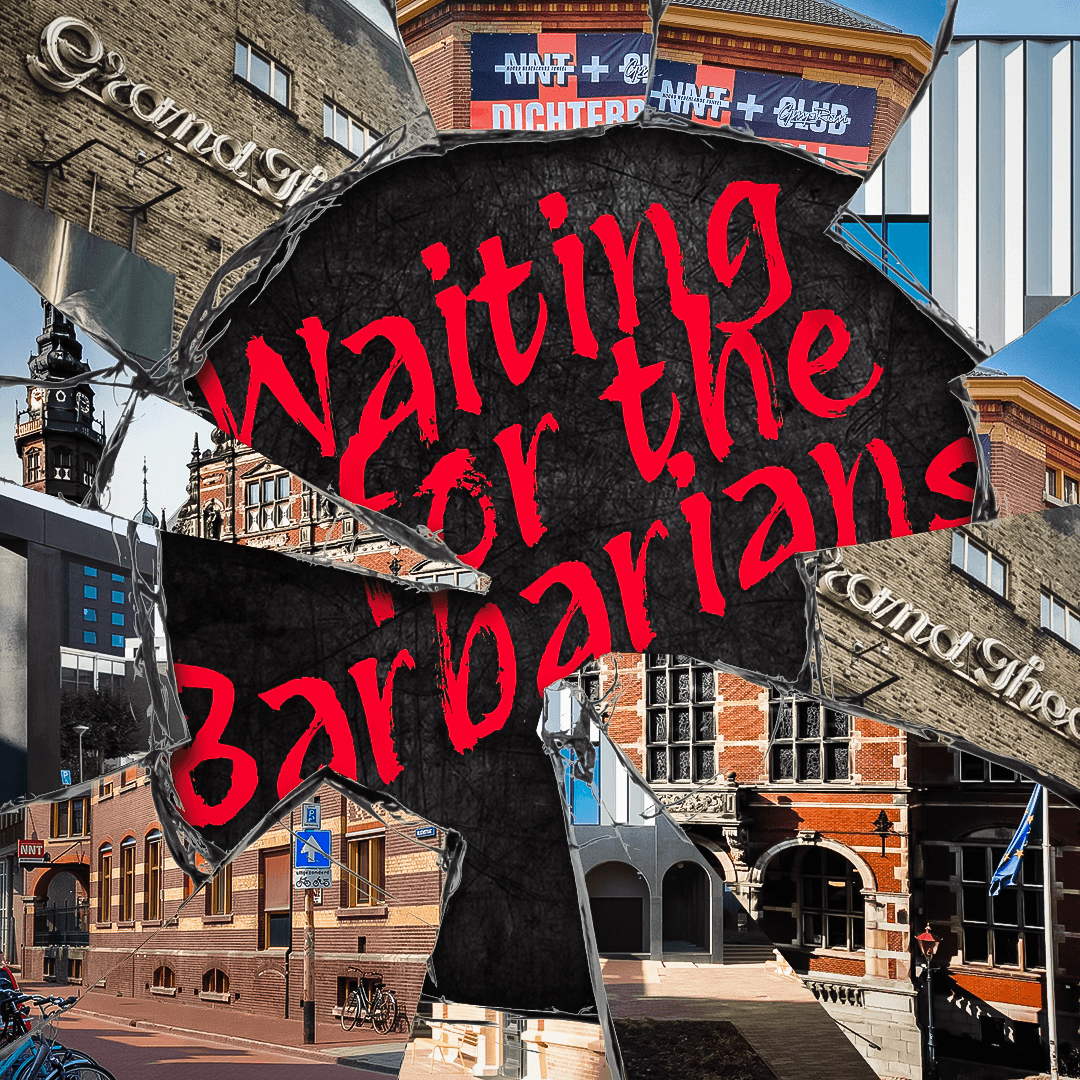
Waiting for the Barbarians
University of Groningen
in collaboration with
NITE / Club Guy & Roni
Grand Theatre Groningen
Station Noord
Het Houten Huis
Theater De Steeg
De Noorderlingen
Nederlandse Reisopera
Studio X
Wednesday 23 September to Saturday 26 September 2026
Deadline for submissions: 23 January 2026
What are we waiting for, assembled in the forum?
The barbarians are due here today.
C.P. Cavafy
The 2026 EASTAP conference is organized in parallel with Guy Weizman’s staging of Philip Glass’s opera Waiting for the Barbarians (Nederlandse Reisopera), to premiere on 26 September 2026 at SPOT Groningen.
Taking its title from the production of Glass’s opera, EASTAP conference explores the dramaturgical, philosophical, and political configurations of waiting in theatre and performance. The opera itself adapts J.M. Coetzee’s novel of the same name, itself a reimagining of C.P. Cavafy’s 1904 poem, tracing a genealogy of waiting across literary and theatrical forms. The conference invites contributions that examine how waiting, understood both as a thematic concern and affective condition, operates within theatre and across socio-aesthetic, intermedial, and intertextual engagements with novel, poetry, and opera.
Waiting provides a dramaturgical mechanism that structures theatrical time around the expectations and anticipations of characters and audiences, and the interplay between them. In (high) modernist and postdramatic theatre, the suspense gives way to suspension, rooted in repetition, cyclical patterns, and stagnation. This suspension disrupts the teleology of plot-driven drama and its progression towards a resolution, turning the performance into a metatheatrical self-reflective apparatus. From Beckett’s Waiting for Godot to Gao Xingjian’s The Bus Stop, waiting transforms duration into tension around the imminent arrival, perpetually anticipated yet continuously deferred or absent; an acute sense or perhaps even a ‘structure of feeling’ that speaks to the present socio-political condition, both locally and globally.
When the awaited figure is imagined as the barbarian, as in Cavafy, Coetzee, and Glass, waiting acquires a political inflection. The discourse of barbarism and civilization has long structured artistic and cultural imaginaries, shaping perceptions of Self and Other, empire and subject, citizen and invader, oppressor and oppressed. This opposition can be traced to Greek theatre, where tragic narratives constructed the “barbarian” as the negative mirror-image of Greek civic values. But the “barbarian” has long circulated within Western artistic discourses not only as a construct of the Other, but also as a means to define the radical Self. The Futurists famously self-proclaimed as barbarians (‘Ebbene, sì, siamo barbari!’, Marinetti 1914), while the Surrealists declared, ‘There is no doubt that we are barbarians, because a certain kind of civilization disgusts us’ (‘La Révolution surréaliste’, 1925). Such statements, characteristic of the historical avant-garde’s construction of the primitive as an antithesis to dominant cultural and social paradigms, nevertheless reinforce the binary between civilization and barbarism.
Taking account of these discourses and their artistic articulations, the conference seeks to explore how the image of the barbarian mobilizes collective imagination, memory, and action. The anticipated barbarian elicits responses ranging from feelings of powerlessness and inaction to engagement with rhetoric of conflict and war. Waiting for the barbarian, therefore, enacts a dramaturgy of social and political imaginaries that is anything but passive. It compels us to give reckoning to the injurious and transformative power of naming and representing within the institutions that define a civilization, while recognizing the barbarian within the Self.
EASTAP 2026 invites scholarly and artistic debate on ‘waiting for the barbarian’ as a generative temporal and imaginative framework that produces new forms of identification, collective being, and political life.
Key axes and questions include:
Temporality / Narrativity / Dramaturgy
- How do waiting, suspension, and ambiguity (re)structure conventional theatrical and narrative temporalities such as progression, climax, and resolution?
- In what ways do works that adapt or allude to the theme ‘Waiting for the Barbarians’ reconfigure narratives of waiting across poetic, novelistic, dramatic, and operatic forms?
- What counter-narratives emerge when the figure of the “barbarian” is withheld, deferred, or revealed to be absent?
Social Imaginary / Resistance / Institutional Critique
- How do theatre and the performing arts participate in constructing, contesting, or transforming social imaginaries around the idea, figure or meme of the barbarian?
- How do anticipation and social injury in theatre and performance shape collective and individual imaginings of the barbarian as well as ethical modes of response-ability regarding Otherness?
- How do contemporary intermedial practices, across novel, poetry, opera, stage, visually and affectively shape social imaginaries tied to civilization, identity, empire, or exclusion?
- How is social justice and resilience enacted through cultural policy and institutional dramaturgies?
Relationality / Suture / Critical Borders:
- In what ways do dramaturgies of waiting cultivate collective forms of being-together, even amid tensions of fear, anticipation, or uncertainty?
- How do feelings of injustice (like shaming, othering, or discrimination) take shape in artistic representations, performative acts, and collective life?
- How might acknowledging the “barbarian within ourselves” open pathways toward new relational modalities, be they aesthetic, political, or philosophical?
- How can the figure of the barbarian be reclaimed to articulate border-transversal identities, countering dominant narratives of threat and otherness?
- What does it mean to confront the “barbarian within ourselves,” and how does this destabilize entrenched internalized cultural boundaries?
We welcome proposals on, but not limited to the following topics:
- Waiting as a state of emergency, as surrender, and as forms of endurance, refusal, and resistance
- Dramaturgies of suspension, durational performance, permanent temporariness
- Antiquity and the “barbarian”: how representations of the Other in classical theatre prompt dramatic events and generate ethical tensions in performance
- Postponement, delay, and deferral in avant-garde/modernist, postdramatic, and contemporary (music) theatre, dance, and performing arts
- Institutional and social dramaturgies, DEI policy incentives, performative democracy
- (In/en)action as method and critique, response-ability, care ethics, agonistic solidarity
- Affect in performance: boredom, anxiety, hope
- Postcolonial imaginaries and emergent temporalities
- Politics of sound and music, voicing the Other, musicalization, ‘civilized’ listening
- Spectatorship, audience expectations of temporal suspension
- (Post)modernity as a project producing modes of barbarism through rationalization, technocratic power, and systemic violence
We encourage interdisciplinary approaches spanning drama and theatre studies, classical reception and critical ancient world studies, opera studies, dance studies, performance studies, cultural studies, art/music/theatre sociology, performance philosophy, comparative studies, policy research, and more. This conference aims to facilitate discussions, knowledge exchange, and collaborations among diverse participants.
EASTAP Emerging Scholars Forum 2026
The Emerging Scholars Forum (ESF) gives early career researchers an opportunity to present their research in a supportive environment with room for debate and feedback. It is also a community for networking with other emerging scholars and will include a social event. Papers for the ESF can follow the call theme of “Waiting for the Barbarians” or present a topic from the scholar’s own ongoing research.
Each participating scholar will have max. 10 minutes for their paper/performance presentation to allow more time for discussion and feedback. We recommend that you focus your paper/presentation on a specific issue or problematic you would like to discuss, instead of presenting the general scope of your research. Keep contextualisation short and focus on a specific case, theory, methodology and/or set of concepts, and the questions which you would like to raise in relation to these.
If you wish to participate in the Emerging Scholars Forum, please submit as indicated below, stating clearly in the headline or the header that your paper is proposed for the Emerging Scholars Forum.
Contributions are welcome in the form of:
- Paper (15 minutes maximum)
- Performance presentation (5-10 minutes – please note that in this mode the presenter must be able to present within a standard conference format, i.e. in a confined space, with minimal additional technical support)
The conference will include curated keynote discussions, performances, and artist round tables.
Important dates:
- Abstract submission deadline: 23 February 2026 (at 23:59)
- Notification of acceptance: 1 March 2026
- Conference dates: 23-26 September 2026 (ExCom on 22 September 2026)
- Fee: 130 Euros (70 Euros – Emerging Scholars only)
The fee will include catering; coffee breaks; discounts for select events at partner venues and theatres. For accommodation, a list with recommended hotels will be provided.
How to submit:
Abstracts should be no more than 300 words. Please include:
- a title
- keywords (up to 5)
- indication if the submission is for a paper OR a performative lecture
- indication of your role (academic scholar OR practitioner/artist)
- affiliation
- indication of the selected fields
- equipment required for the paper presentation OR the performative lecture
- language of the paper presentation OR the performative lecture
- a short bio (100 words) for all authors
Submit your proposal as a Word document or PDF to eastap26@rug.nl by the above-mentioned deadline. Accepted languages are English, French, Dutch and German.
For inquiries or further information, please contact Pieter Verstraete and Eleftheria Ioannidou (coordinators of the conference) at p.m.g.verstraete@rug.nl or e.ioannidou@rug.nl.
Organizing Committee (University of Groningen)
Pieter Verstraete
Eleftheria Ioannidou
Lucia van Heteren
Marlieke Wilders